
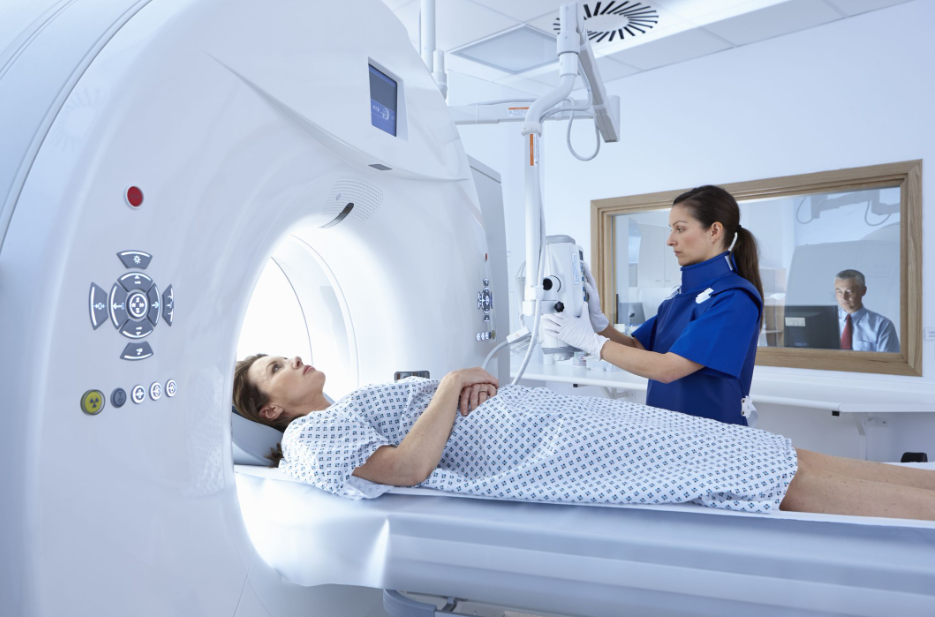
CAs in the case of MRI, CT achieves images with high temporal and spatial resolution, which makes it an ideal technique for studying the morphology of vessels, their walls, surgical anastomoses, the airway, the lung parenchyma, and sometimes assessment of ventricular function.
Indications
The main indications for performing CT in patients with congenital heart disease include:
Evaluation of the coronary vessels: it not only evaluates their outlet and proximal path, but also their distal path, calcium deposits on their walls (calcium quantification or Calcium-Score) and is a better method than MRI to assess the complications secondary to surgical procedures where they are manipulated as in the Transposition of the Great Arteries.
Evaluation of patients repaired with stents or embolization coils
Patients with pacemakers, those not compatible with MRI.
Evaluation of vascular rings, since it better evaluates their relationship with the rest of the mediastinal structures, including the airway and the esophagus.
The indication in patients with claustrophobia is relative. In my opinion, with patience and adequate preparation they would withstand the MRI. If this is not possible, consideration should be given to performing an MRI with sedation, since in any case, CT, despite current technical advances, still involves a high dose of radiation get your tests from Lab Uncle.
In patients in a very serious clinical situation that is difficult to control, or in immediate post-surgical situations who need a rapid study (5-10 minutes).
Advantages and disadvantages of CT in relation to MRI
Advantages:
A shorter scan time. In children it allows less sedation / anesthesia to be used
It is compatible in patients with pacemakers and metallic devices.
Greater availability.
Simultaneous assessment of the heart and lung with their airways.
Disadvantages
High doses of radiation. It is the main limiting factor for performing a CT, since they will need multiple evolutionary controls throughout their lives and the radiation dose is added test after test.
Need for intravenous contrast. In CT, unlike MRI, it will always be necessary to administer intravenous contrast. The contrast used in CT is based on the chemical element iodine.
Less functional information (ventricular function) than MRI
In addition, vascular calcifications or surgical material can distort the image and make it difficult to see the lumen of the vessel well. Pacemakers and other metallic devices can also produce artifacts, although in the latest generation CT, all these artifacts are minor.
Also Read: Computed Tomography (CT): what is it for, advantages and disadvantages
Examples of images obtained in the CT
In the upper images on the left, we observe the small caliber of the (hypoplastic) aortic arch (arrow) and an enlarged ductus () in a 5-day-old patient with suspected aortic arch interruption. In the upper images on the right, we observe a complete double aortic arch, with branch asymmetry, the right side being larger in caliber () in a 6-year-old patient with respiratory symptoms. The 3D reconstruction of the airway shows the stenosis it produces in the tracheal lumen (*).
In the upper images on the left, we can see a coarctation of the aorta treated with a stent in MIP projection and its VRT-3D reconstruction in a 16-year-old patient.
In the upper images on the right we see a stenosis of the pulmonary veins (arrow) in a 1-year-old child (left) and a large ASD (right)
In the upper image on the left we observe a left coronary artery aneurysm and partially calcified wall (arrow) in an 8-year-old patient with Kawasaki disease.
In the upper image on the right we observe an anomalous origin of the left coronary artery in the pulmonary trunk and subsequent correction, with reimplantation in the aorta using a Dacron tube (Arrow) in a 3-year-old girl.


deep web drug markets how to access dark web
tor markets 2023 darknet market list
dark web drug marketplace bitcoin dark web
deep web drug store free dark web
tor market darknet drug market
dark market darkmarket link
darknet drug links free dark web
dark website darknet search engine
drug markets onion darkmarket 2023
darkmarket 2023 best darknet markets
deep dark web tor market
dark net darkmarket 2023
darkmarket deep dark web
darkmarket url dark website
dark market onion dark web drug marketplace
tor market darkmarkets
darknet markets tor darknet
darkmarket 2023 blackweb
п»їerectile dysfunction medication: buy ed pills online – mens ed pills
tor market links darknet market lists
blackweb how to access dark web
bitcoin dark web black internet
dark web site dark web market
dark web search engine dark web market links
darknet drug links dark market list
darknet drug store onion market
dark market onion darkmarket list
tor markets 2023 dark web link
blackweb official website black internet
線上賭場
台灣娛樂城/線上賭場(現金網)的特殊稱呼以及其歷史:
台灣對於線上賭場的特殊稱呼是「娛樂城/線上賭場(現金網)」。這種稱呼的背後有其原因,主要是因為線上賭場在台灣架設及經營是違法的。在早期經營線上博弈被抓的風險非常高,因此業者採用了「娛樂城」這樣的模糊代稱,以規避警方的注意。當時的網絡搜尋引擎尚未普及,這樣的代稱在一定程度上能夠達到避免被發現的效果。
台灣娛樂城/線上賭場的歷史可以分為幾個時期:
1. 網路未興盛時代:
– 現場賭場時期(1980年代):賭博活動主要發生在實體賭場,包括家庭電話上的BB CALL呼叫器、六合彩、大家樂等方式。
– 電銷賭場時期(21世紀):隨著手機的普及,人們開始使用手機進行博弈,主要包括中華職棒簽賭和六合彩等。
2. 線上博弈時期(2013年開始):
– 網際網路普及後,原本的信用版博弈業者開始轉戰線上賭場(娛樂城),開啟了線上博弈的時代。
– 由於在台灣,線上賭場架設和經營是違法的,合法的線上賭場通常選擇在合法的國家進行架設。
– 開設線上賭場主要採用「現金儲值」的方式,以規避法律風險。玩家將現金兌換成賭資,進行投注。
3. 娛樂城商業模式的轉變:
– 早期的娛樂城業者往往將客服人員與金流(出入款)的職責綁在一起,
容易成為執法機關定罪的基礎。
– 現代的娛樂城業者開始將客服人員、金流服務商以及廣告行銷外包,以降低定罪風險。
– 由於遠端工作的普及以及區塊鏈技術的應用,未來娛樂城業者可能更加難以被追查,這也凸顯了博弈產業合法化的必要性。
娛樂城業者面臨的風險主要來自以下幾個方面:
– 架站主機:娛樂城業者通常在合法的國家進行架設,使執法機關難以從此方面下手追查。
– 客服人員:娛樂城業者可能在台灣設立辦公室提供客服服務,這也是執法機關可能進行搜索的目標之一。
– 金流(出入款):娛樂城業者使用人頭帳戶進行金流操作,以規避監管機構的追蹤,但也存在風險。
– 行銷推廣:娛樂城業者需要進行廣告推廣來吸引玩家,行銷推廣方式也可能成為執法機關追查的一環。
娛樂城業者商業模式的轉變也反映了博弈產業的發展趨勢。隨著網路技術的成熟和商業模式的創新,博弈產業可能朝著合法化和監管的方向發展,以確保公信力、保護玩家權益並徵收相應的稅收。
https://sisidigitaltools.com/website-reviewer/domain/rg8888.org
darknet markets dark markets 2023
http://pharmfd.com/# legal online pharmacy coupon code
dark web markets darknet drug links
dark web search engines tor market
tor markets darkmarkets
dark web access tor dark web
dark net darknet marketplace
darkmarket url darknet market list
dark web sites links darkmarket list
darknet drugs dark web market
dark web links dark net
dark web search engines darknet drug market
dark web market links onion market
dark web access darknet links
dark net darknet site
dark web drug marketplace darknet seiten
dark web link tor market url
top ed pills: buy ed pills online – medications for ed
deep web drug markets tor markets
onion market tor markets links