
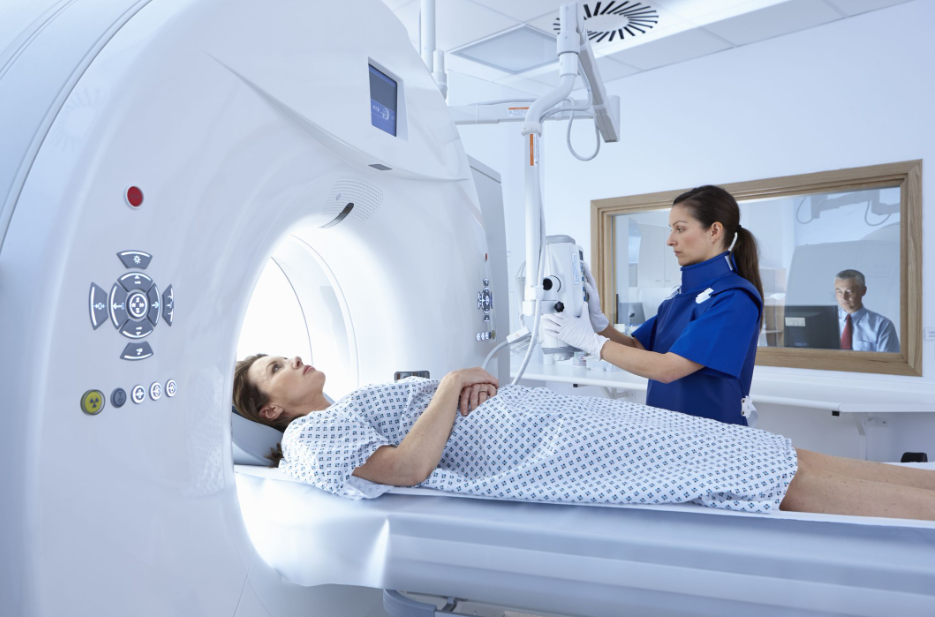
CAs in the case of MRI, CT achieves images with high temporal and spatial resolution, which makes it an ideal technique for studying the morphology of vessels, their walls, surgical anastomoses, the airway, the lung parenchyma, and sometimes assessment of ventricular function.
Indications
The main indications for performing CT in patients with congenital heart disease include:
Evaluation of the coronary vessels: it not only evaluates their outlet and proximal path, but also their distal path, calcium deposits on their walls (calcium quantification or Calcium-Score) and is a better method than MRI to assess the complications secondary to surgical procedures where they are manipulated as in the Transposition of the Great Arteries.
Evaluation of patients repaired with stents or embolization coils
Patients with pacemakers, those not compatible with MRI.
Evaluation of vascular rings, since it better evaluates their relationship with the rest of the mediastinal structures, including the airway and the esophagus.
The indication in patients with claustrophobia is relative. In my opinion, with patience and adequate preparation they would withstand the MRI. If this is not possible, consideration should be given to performing an MRI with sedation, since in any case, CT, despite current technical advances, still involves a high dose of radiation get your tests from Lab Uncle.
In patients in a very serious clinical situation that is difficult to control, or in immediate post-surgical situations who need a rapid study (5-10 minutes).
Advantages and disadvantages of CT in relation to MRI
Advantages:
A shorter scan time. In children it allows less sedation / anesthesia to be used
It is compatible in patients with pacemakers and metallic devices.
Greater availability.
Simultaneous assessment of the heart and lung with their airways.
Disadvantages
High doses of radiation. It is the main limiting factor for performing a CT, since they will need multiple evolutionary controls throughout their lives and the radiation dose is added test after test.
Need for intravenous contrast. In CT, unlike MRI, it will always be necessary to administer intravenous contrast. The contrast used in CT is based on the chemical element iodine.
Less functional information (ventricular function) than MRI
In addition, vascular calcifications or surgical material can distort the image and make it difficult to see the lumen of the vessel well. Pacemakers and other metallic devices can also produce artifacts, although in the latest generation CT, all these artifacts are minor.
Also Read: Computed Tomography (CT): what is it for, advantages and disadvantages
Examples of images obtained in the CT
In the upper images on the left, we observe the small caliber of the (hypoplastic) aortic arch (arrow) and an enlarged ductus () in a 5-day-old patient with suspected aortic arch interruption. In the upper images on the right, we observe a complete double aortic arch, with branch asymmetry, the right side being larger in caliber () in a 6-year-old patient with respiratory symptoms. The 3D reconstruction of the airway shows the stenosis it produces in the tracheal lumen (*).
In the upper images on the left, we can see a coarctation of the aorta treated with a stent in MIP projection and its VRT-3D reconstruction in a 16-year-old patient.
In the upper images on the right we see a stenosis of the pulmonary veins (arrow) in a 1-year-old child (left) and a large ASD (right)
In the upper image on the left we observe a left coronary artery aneurysm and partially calcified wall (arrow) in an 8-year-old patient with Kawasaki disease.
In the upper image on the right we observe an anomalous origin of the left coronary artery in the pulmonary trunk and subsequent correction, with reimplantation in the aorta using a Dacron tube (Arrow) in a 3-year-old girl.


ciprofloxacin generic price: ciprofloxacin – buy cipro cheap
zithromax antibiotic without prescription: buy zithromax – buy zithromax canada
hydroxychloroquine interactions hydroxychloroquine henry ford study hydroxychloroquine sulfate over the counter
I savor, lead to I found exactly what I used to be looking for. You have ended my 4 day long hunt! God Bless you man. Have a nice day. Bye
нейросеть онлайн
lexapro discussions escitalopram for adhd para que sirve escitalopram 10 mg
mexican pharmaceuticals online: reputable mexican pharmacies online – mexican border pharmacies shipping to usa
reddit onion list incognito link [url=https://kingdomdarkwebmarket.com/ ]deep sea darknet market [/url]
Cocorico Market link darknet adressen [url=https://heinekenoniondarkmarket.com/ ]how to access the black market [/url]
how to get off of cymbalta https://cymbaltaduloxetineztn.com/ cymbalta and hot flashes
что такое нейросеть
буба трейлер
hey there and thank you for your information I’ve definitely picked up anything new from right here. I did however expertise some technical issues using this site, since I experienced to reload the web site a lot of times previous to I could get it to load properly. I had been wondering if your web hosting is OK? Not that I am complaining, but sluggish loading instances times will very frequently affect your placement in google and can damage your quality score if advertising and marketing with Adwords. Anyway I’m adding this RSS to my e-mail and can look out for a lot more of your respective interesting content. Make sure you update this again soon.
reputable mexican pharmacies online: mexican border pharmacies shipping to usa – mexico drug stores pharmacies
free deep web links darknet market links buy ssn [url=https://cyphermarket-darknet.com/ ]reliable darknet markets [/url]
norvasc hctz together why does amlodipine cause edema is norvasc a diuretic
Your article made me suddenly realize that I am writing a thesis on gate.io. After reading your article, I have a different way of thinking, thank you. However, I still have some doubts, can you help me? Thanks.
нейросеть midjourney
dark markets romania best darknet gun market [url=https://cypher-darkmarket-online.com/ ]how to use deep web on pc [/url]
https://overthecounter.pro/# omeprazole over the counter
https://overthecounter.pro/# over the counter medicine
seroquel alternatives no weight gain seroquel how does it work quetiapine fumarat
darknet market links 2023 best darknet market for psychedelics [url=https://world-darknet-drugstore.com/ ]darknet market vendors [/url]
access the black market deep web drug url [url=https://world-drugs-market.com/ ]darknet market 2023 reddit [/url]
pills like viagra over the counter cvs: over the counter ed medication – over the counter asthma inhalers
When I originally commented I clicked the “Notify me when new comments are added” checkbox and now each time a comment is added I get several
e-mails with the same comment. Is there any way you can remove people from that service?
Appreciate it!
what is the medication omeprazole zegerid vs prilosec prilosec and probiotics
http://overthecounter.pro/# over the counter cold sore medicine
1ACE
sertraline counseling points zoloft and wine sertraline 25 mg reviews
After checking out a number of the blog posts on your website, I really like your way of blogging. I book marked it to my bookmark site list and will be checking back soon. Please check out my web site as well and let me know how you feel.
нейросеть аниме
https://overthecounter.pro/# over the counter tapeworm treatment for dogs
over the counter diuretics: over-the-counter drug – over-the-counter
нейросеть midjourney
dark web markets reddit darknet drug dealer [url=https://worldoniondarkweb.com/ ]darknet drugs malayisa [/url]
switching from cymbalta to zoloft https://cymbaltaduloxetinesec.com/ how long to get duloxetine out of your system
darknet drug markets 2023 bohemia darknet market [url=https://heinekendrugsonline.com/ ]tor market nz [/url]
нейросеть аниме
нейросеть midjourney
great post, very informative. I’m wondering why the other experts of this sector do not realize this. You should continue your writing. I am sure, you have a huge readers’ base already!
Enjoyed examining this, very good stuff, thankyou.
https://overthecounter.pro/# over the counter asthma inhaler
lexapro 5mg vs 10mg https://lexaproescitalopramogv.com/ escitalopram ox
https://overthecounter.pro/# over the counter muscle relaxer
нейросеть midjourney
нейросеть midjourney
нейросеть midjourney
This is the right web site for anybody who wants to find out about this topic. You realize so much its almost hard to argue with you (not that I actually would want toHaHa). You definitely put a new spin on a topic that’s been written about for years. Great stuff, just excellent!
Thanks for finally writing about > Multislice Computed Tomography in Congenital Heart Disease (CT) < Loved it!
uti over the counter medicine: over the counter antibiotic – over the counter pink eye medicine
dark web hitmen Kingdom url [url=https://kingdom-darkmarket.com/ ]darknet market sites and how to access [/url]