
What is an MRI brain scanner and how does it work?
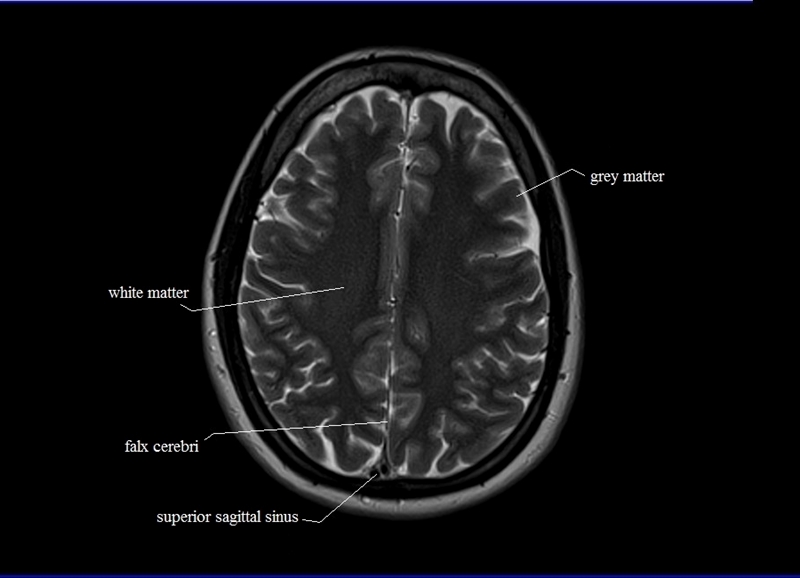
The MRI scanner is basically a piece of equipment that studies the magnetic properties of tissues. Each tissue has different magnetic parameters, and, more importantly, these parameters normally vary when there is an injury. This fact allows the team to make different types of images, assigning a specific gray scale to the different magnetic parameters that it measures.
The advantage of having the possibility of obtaining different contrasts is that it allows for detecting a greater number of lesions, those that are invisible in one type of contrast stand out in another, as is the case with this ischemic lesion due to blockage of an artery:
brain magnetic resonance imaging lesions
Therefore, a brain MRI scan usually consists of several images, each of which is acquired in between 2 and 8 minutes. Hence the total duration of the scan.
But how does the teamwork?
To study the magnetic properties of tissues we need a magnetic field and, for this, a magnet. In short, it is what the tube is: a huge electromagnet (electric current rotating through a circuit that generates a magnetic field) with enough force to lift a car.
For this reason, MRI is contraindicated in people with pacemakers (it could stop) and other metallic, electronic magnetic devices. When the person is introduced into the tube, each of their tissues is magnetized according to their characteristics, very little but enough to be detected and to carry out the study. The team searches for the MRI of the tissues with radio waves.
This is another advantage of magnetic resonance imaging: it does not use X-rays or ionizing radiation, only radio waves in the region of the modulated frequency (FM from 63 to 126 MHz, depending on the team) that are harmless.
Magnetic resonance makes the magnetization of the tissues vary in direction. When the magnetic resonance ceases, magnetic relaxation occurs, the way back to the starting position, each tissue at its own speed. The magnetic relaxation in turn generates a wave that is picked up by an antenna. The information from the wave is sent to a computer that reconstructs the layout of the tissues, thereby generating the image.
Brain MRI as a research tool
Since its inception, magnetic resonance imaging has aroused the interest of scientists. For Dr. Falcón “its versatility allows obtaining not only anatomical images in different contrasts, but also dynamic and functional images, extremely useful information in understanding the functioning of the brain and the processes involved in any pathology. What was previously only could verify in post-mortem studies it is now visible in vivo with scans, somewhat annoying but innocuous, of just under an hour” for more info visit labuncle.com.
The main difference between MRI used for diagnosis or as a research tool is the precision, much higher in the case of research, and often the type of information that is obtained from the tissues. Let’s review some research explorations in neuroimaging with magnetic resonance:
1) Anatomical images
The objective is to know the anatomy of the brain with maximum precision, to take reliable measurements that can be monitored over time. The difference with equivalent diagnostic images is only the resolution.
Below is an example of a diagnostic image (left), its equivalent in research (center) and super-resolution (right). The first is sufficient to rule out pathology, but is it the quantitative measurements would be inaccurate due to the blurring of the edges.
2) Anatomical images without diagnostic value
This case would be, for example, the study of white matter tracts that inform which part of the brain is connected to which other part and the strength of these connections (an example below). This information allows us to understand the network structure of the brain and its functioning when performing different tasks.
3) Functional images
Complementary to the previous one. It determines which part of the brain is activated or deactivated when performing a certain task and allows us to understand how the brain works (below, the activation when listening to emotional music, with the activation of the auditory -lateral-, emotional -central- and frontal -the superior cortex -) and what goes wrong when there is mental dysfunction. They also make it possible to determine which parts of the brain work synchronously in the resting state of mental activity.
4) Dynamic images
For example, the measurements of flow in a blood vessel, which allow determining how much blood and at what speed it passes through a certain artery; the carotids in the image below. It also makes it possible to indirectly determine some parameters such as the stiffness of the arteries or lipid plaques, which help determine a person’s vascular risk.


Как узнать рейтинг букмекера
букмекерские приложения марафон букмекерская контора .
baclofen vs tizanidine
venlafaxine withdrawal symptoms
Букмекеры с высоким рейтингом
мобильные букмекерские конторы вход букмекерская .
clarithromycin tamsulosin
Топ-10 букмекеров по рейтингу
букмекерские приложения марафон букмекерская контора .
voltaren and verapimil
Обзор рейтинга букмекеров
рейтинг рейтинг букмекеров .
Can you be more specific about the content of your article? After reading it, I still have some doubts. Hope you can help me.
PBN sites
We will build a web of self-owned blog network sites!
Advantages of our private blog network:
We perform everything so google doesn’t realize THAT THIS IS A privately-owned blog network!!!
1- We obtain web domains from distinct registrars
2- The primary site is hosted on a virtual private server (Virtual Private Server is fast hosting)
3- Additional sites are on various hostings
4- We attribute a unique Google account to each site with confirmation in Google Search Console.
5- We create websites on WP, we do not employ plugins with aided by which malware penetrate and through which pages on your websites are created.
6- We don’t repeat templates and employ only exclusive text and pictures
We do not work with website design; the client, if wanted, can then edit the websites to suit his wishes
exprimegranada.com
この記事を読んで、たくさんのインスピレーションを受けました。ありがとうございます。
largestcatbreed.com
사실 도중에 Hongzhi 황제는 시간이 매우 느리게 흐르는 것을 느꼈습니다.
berlin job search
[…]please check out the websites we stick to, including this one particular, because it represents our picks in the web[…]
how many zofran can i take while pregnant
indian pharmacy paypal https://indiaph24.store/# п»їlegitimate online pharmacies india
Online medicine order
wellbutrin ve cipralex
zyprexa dosage range
PBN sites
We will establish a network of privately-owned blog network sites!
Pros of our privately-owned blog network:
We perform everything so google does not comprehend that this is A privately-owned blog network!!!
1- We purchase domains from distinct registrars
2- The principal site is hosted on a VPS hosting (Virtual Private Server is fast hosting)
3- Additional sites are on distinct hostings
4- We assign a unique Google ID to each site with confirmation in Search Console.
5- We develop websites on WP, we do not use plugins with the help of which malware penetrate and through which pages on your websites are established.
6- We don’t duplicate templates and utilise only exclusive text and pictures
We do not work with website design; the client, if desired, can then edit the websites to suit his wishes
zanetvize.com
Zhu Houzhao는 마음이 쓰라리고 무언가를 말하고 싶었습니다.
generic for zetia
bmipas.com
この記事はとても有益で、読む価値があります。
zofran iv uses
Unlocking MyStatLab Quiz Answers: A Step-by-Step Guide
Discover strategies to effectively navigate MyStatLab quizzes, ensuring you grasp key concepts and find accurate MyStatLab Quiz Answers for academic success.
zyprexa and diabetes
buying prescription drugs in mexico: mexico pharmacy – buying prescription drugs in mexico online
Earn Money by Playing Fun Games in Kenya
best online casino games kenya casino games online for real money .
Win Cash Instantly with Online Games in Kenya
best online casino games to win money real money online casinos .
Online Games that Pay Out Real Money in Kenya
best online casino games kenya casino games online for real money .
Best Games to Win Money in Kenya
best online casino games to win money real money online casinos .
Earn Real Cash Playing Mobile Games in Kenya
best online casino games kenya games that pay real money in kenya .
buy medicines online in india http://indiaph24.store/# reputable indian pharmacies
indian pharmacy
thewiin.com
이 무거운 보호 아래 벽에는 커다란 지도가 걸려 있었다.
психологическая помощь взрослым https://w-495.ru/
консультациЯ психолога в москве недорого https://w-495.ru/
bmipas.com
日常生活で直接役立つ実用的な情報が豊富で、素晴らしい記事です。
центр психологиЯ https://w-495.ru/
Unlocking Success: MyMathLab Answers
In the world of online education, MyMathLab is a powerful tool for learning mathematics. However, students often seek MyMathLab answers to excel in their coursework. While using answers as a shortcut may seem tempting, it’s essential to remember that genuine learning comes from understanding the concepts. Balancing resources like MyMathLab with dedicated study is the key to mastering maths.
подбор психолога https://w-495.ru/
отзывы психолог https://w-495.ru/
психолог 17 https://w-495.ru/
платный психолог https://w-495.ru/
психолог профи ру https://w-495.ru/
дипломированный психолог https://w-495.ru/
услуги психолога сайт https://w-495.ru/
найти хорошего психолога https://w-495.ru/
психолог длЯ https://w-495.ru/
ラブドール アニメ ダッチワイフがポルノ依存症を止めるのをどのように助けてくれたか
I don’t think the title of your article matches the content lol. Just kidding, mainly because I had some doubts after reading the article.
Get Paid to Play Games in Kenya
best online casino games kenya casino games online for real money .
Play and Earn Real Money Online in Kenya
best online casino games to win money real money online casinos .