
What is an MRI brain scanner and how does it work?
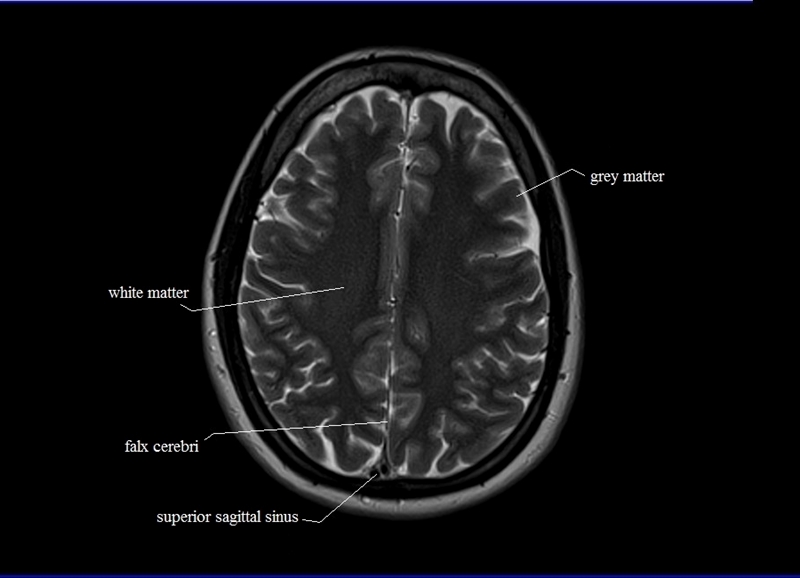
The MRI scanner is basically a piece of equipment that studies the magnetic properties of tissues. Each tissue has different magnetic parameters, and, more importantly, these parameters normally vary when there is an injury. This fact allows the team to make different types of images, assigning a specific gray scale to the different magnetic parameters that it measures.
The advantage of having the possibility of obtaining different contrasts is that it allows for detecting a greater number of lesions, those that are invisible in one type of contrast stand out in another, as is the case with this ischemic lesion due to blockage of an artery:
brain magnetic resonance imaging lesions
Therefore, a brain MRI scan usually consists of several images, each of which is acquired in between 2 and 8 minutes. Hence the total duration of the scan.
But how does the teamwork?
To study the magnetic properties of tissues we need a magnetic field and, for this, a magnet. In short, it is what the tube is: a huge electromagnet (electric current rotating through a circuit that generates a magnetic field) with enough force to lift a car.
For this reason, MRI is contraindicated in people with pacemakers (it could stop) and other metallic, electronic magnetic devices. When the person is introduced into the tube, each of their tissues is magnetized according to their characteristics, very little but enough to be detected and to carry out the study. The team searches for the MRI of the tissues with radio waves.
This is another advantage of magnetic resonance imaging: it does not use X-rays or ionizing radiation, only radio waves in the region of the modulated frequency (FM from 63 to 126 MHz, depending on the team) that are harmless.
Magnetic resonance makes the magnetization of the tissues vary in direction. When the magnetic resonance ceases, magnetic relaxation occurs, the way back to the starting position, each tissue at its own speed. The magnetic relaxation in turn generates a wave that is picked up by an antenna. The information from the wave is sent to a computer that reconstructs the layout of the tissues, thereby generating the image.
Brain MRI as a research tool
Since its inception, magnetic resonance imaging has aroused the interest of scientists. For Dr. Falcón “its versatility allows obtaining not only anatomical images in different contrasts, but also dynamic and functional images, extremely useful information in understanding the functioning of the brain and the processes involved in any pathology. What was previously only could verify in post-mortem studies it is now visible in vivo with scans, somewhat annoying but innocuous, of just under an hour” for more info visit labuncle.com.
The main difference between MRI used for diagnosis or as a research tool is the precision, much higher in the case of research, and often the type of information that is obtained from the tissues. Let’s review some research explorations in neuroimaging with magnetic resonance:
1) Anatomical images
The objective is to know the anatomy of the brain with maximum precision, to take reliable measurements that can be monitored over time. The difference with equivalent diagnostic images is only the resolution.
Below is an example of a diagnostic image (left), its equivalent in research (center) and super-resolution (right). The first is sufficient to rule out pathology, but is it the quantitative measurements would be inaccurate due to the blurring of the edges.
2) Anatomical images without diagnostic value
This case would be, for example, the study of white matter tracts that inform which part of the brain is connected to which other part and the strength of these connections (an example below). This information allows us to understand the network structure of the brain and its functioning when performing different tasks.
3) Functional images
Complementary to the previous one. It determines which part of the brain is activated or deactivated when performing a certain task and allows us to understand how the brain works (below, the activation when listening to emotional music, with the activation of the auditory -lateral-, emotional -central- and frontal -the superior cortex -) and what goes wrong when there is mental dysfunction. They also make it possible to determine which parts of the brain work synchronously in the resting state of mental activity.
4) Dynamic images
For example, the measurements of flow in a blood vessel, which allow determining how much blood and at what speed it passes through a certain artery; the carotids in the image below. It also makes it possible to indirectly determine some parameters such as the stiffness of the arteries or lipid plaques, which help determine a person’s vascular risk.


фильм
can augmentin cause a yeast infection
I do agree with all the ideas you have introduced in your post. They are very convincing and will definitely work. Still, the posts are too quick for novices. May just you please extend them a bit from next time? Thank you for the post.
statin plus ezetimibe
https://spbhousekupit.ru/
https://spbkupitzhilie.ru/
windowsresolution.com
장엄한 Zhen Guo 경이 갑자기 격렬하게 흔들리기 시작했습니다.
fantastic thanks again and again!!!
https://zhksalezhilie.ru/
jelenakaludjerovic.com
이게 뭐야 국민을 속이기 위한 거짓말이고 사형에 해당하는 범죄다.
https://zhksalehouse.ru/
https://zhksaledom.ru/
megagame
[…]Every once in a while we pick out blogs that we study. Listed below would be the newest web sites that we opt for […]
https://vsegda-pomnim.com/
evisa
[…]Every as soon as inside a although we pick out blogs that we study. Listed beneath would be the newest web pages that we opt for […]
ttbslot.com
Liu Jian은 내부를 들여다보고…매우 무감각한 말을 하고 심호흡을 했습니다.
weight drops
[…]Wonderful story, reckoned we could combine some unrelated data, nonetheless actually really worth taking a look, whoa did one particular study about Mid East has got extra problerms too […]
http://klublady.ru/
contrave weight loss side effects
flexeril for anxiety
17 wsm
[…]always a huge fan of linking to bloggers that I adore but do not get a whole lot of link really like from[…]
25-06 ammo
[…]here are some hyperlinks to sites that we link to for the reason that we think they’re really worth visiting[…]
duromine
[…]Here is a good Blog You might Discover Exciting that we Encourage You[…]
is flomax for women
В нашем кинотеатре https://hdrezka.uno смотреть фильмы и сериалы в хорошем HD-качестве можно смотреть с любого устройства, имеющего доступ в интернет. Наслаждайся кино или телесериалами в любом месте с планшета, смартфона под управлением iOS или Android.
thanks for sharing Η γνώση είναι μαγική δύναμη!
https://kursovyebiolog.ru
https://kursovyebuhgalter.ru
This blog was… how do I say it? Relevant!! Finally I have found something that helped me. Many thanks!
Hey! Do you know if they make any plugins to help with SEO? I’m trying to get my blog to rank for some targeted keywords but I’m not seeing very good results. If you know of any please share. Thanks!
Tremendous things here. I’m very glad to peer your article. Thank you so much and I’m taking a look forward to touch you. Will you please drop me a mail?
Link exchange is nothing else but it is simply placing the other person’s blog link on your page at proper place and other person will also do same for you.
Yes! Finally something about %keyword1%.
Having read this I thought it was really informative. I appreciate you finding the time and effort to put this information together. I once again find myself spending a significant amount of time both reading and leaving comments. But so what, it was still worth it!
Hello there, just became aware of your blog through Google, and found that it is really informative. I’m gonna watch out for brussels. I will appreciate if you continue this in future. A lot of people will be benefited from your writing. Cheers!
Simply wish to say your article is as amazing. The clearness on your publish is simply spectacular and i can assume you are a professional in this subject. Well with your permission allow me to clutch your RSS feed to stay up to date with drawing close post. Thank you one million and please continue the gratifying work.
5 шагов по уходу за рулонным газоном
рулонный газон цена https://rulonnyygazon177.ru/ .
Hey there! I know this is kinda off topic but I was wondering which blog platform are you using for this site? I’m getting fed up of WordPress because I’ve had issues with hackers and I’m looking at options for another platform. I would be great if you could point me in the direction of a good platform.
Идеи для декорирования сада с помощью рулонного газона
рулонный газон купить в московской области цена https://rulonnyygazon177.ru/ .
You’ve made some good points there. I looked on the internet to learn more about the issue and found most individuals will go along with your views on this website.
I am curious to find out what blog system you have been working with? I’m experiencing some minor security problems with my latest site and I would like to find something more safeguarded. Do you have any solutions?
Hi there, I found your website by the use of Google whilst searching for a comparable topic, your site got here up, it seems good. I have bookmarked it in my google bookmarks.
Ahaa, its good conversation concerning this piece of writing here at this blog, I have read all that, so now me also commenting here.
Hmm is anyone else experiencing problems with the images on this blog loading? I’m trying to find out if its a problem on my end or if it’s the blog. Any feed-back would be greatly appreciated.
If you desire to improve your experience simply keep visiting this web site and be updated with the newest information posted here.
Fantastic beat ! I wish to apprentice while you amend your site, how can i subscribe for a blog site? The account aided me a acceptable deal. I had been tiny bit acquainted of this your broadcast provided bright clear concept
Good article! We will be linking to this great article on our site. Keep up the good writing.
Thanks for finally writing about > %blog_title% < Liked it!
Howdy, i read your blog occasionally and i own a similar one and i was just wondering if you get a lot of spam comments? If so how do you prevent it, any plugin or anything you can advise? I get so much lately it’s driving me insane so any help is very much appreciated.
Every weekend i used to visit this web site, as i want enjoyment, as this this website conations actually nice funny information too.