
What is an MRI brain scanner and how does it work?
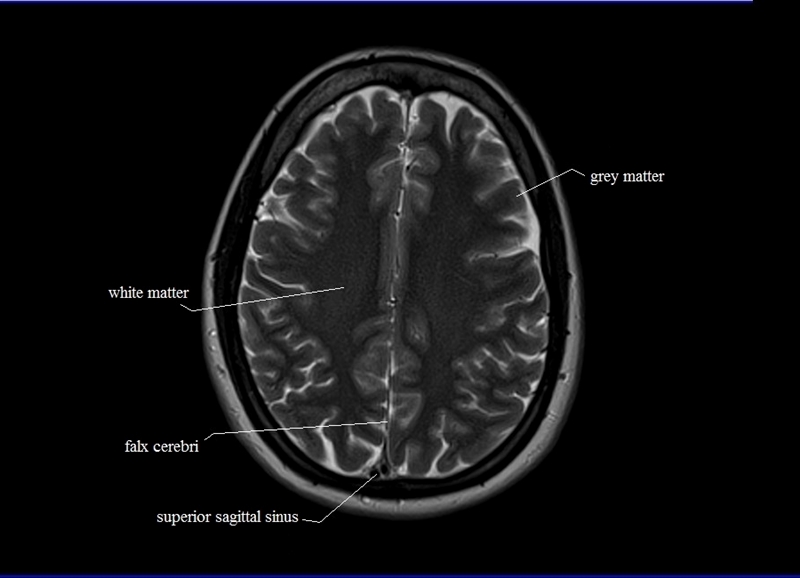
The MRI scanner is basically a piece of equipment that studies the magnetic properties of tissues. Each tissue has different magnetic parameters, and, more importantly, these parameters normally vary when there is an injury. This fact allows the team to make different types of images, assigning a specific gray scale to the different magnetic parameters that it measures.
The advantage of having the possibility of obtaining different contrasts is that it allows for detecting a greater number of lesions, those that are invisible in one type of contrast stand out in another, as is the case with this ischemic lesion due to blockage of an artery:
brain magnetic resonance imaging lesions
Therefore, a brain MRI scan usually consists of several images, each of which is acquired in between 2 and 8 minutes. Hence the total duration of the scan.
But how does the teamwork?
To study the magnetic properties of tissues we need a magnetic field and, for this, a magnet. In short, it is what the tube is: a huge electromagnet (electric current rotating through a circuit that generates a magnetic field) with enough force to lift a car.
For this reason, MRI is contraindicated in people with pacemakers (it could stop) and other metallic, electronic magnetic devices. When the person is introduced into the tube, each of their tissues is magnetized according to their characteristics, very little but enough to be detected and to carry out the study. The team searches for the MRI of the tissues with radio waves.
This is another advantage of magnetic resonance imaging: it does not use X-rays or ionizing radiation, only radio waves in the region of the modulated frequency (FM from 63 to 126 MHz, depending on the team) that are harmless.
Magnetic resonance makes the magnetization of the tissues vary in direction. When the magnetic resonance ceases, magnetic relaxation occurs, the way back to the starting position, each tissue at its own speed. The magnetic relaxation in turn generates a wave that is picked up by an antenna. The information from the wave is sent to a computer that reconstructs the layout of the tissues, thereby generating the image.
Brain MRI as a research tool
Since its inception, magnetic resonance imaging has aroused the interest of scientists. For Dr. Falcón “its versatility allows obtaining not only anatomical images in different contrasts, but also dynamic and functional images, extremely useful information in understanding the functioning of the brain and the processes involved in any pathology. What was previously only could verify in post-mortem studies it is now visible in vivo with scans, somewhat annoying but innocuous, of just under an hour” for more info visit labuncle.com.
The main difference between MRI used for diagnosis or as a research tool is the precision, much higher in the case of research, and often the type of information that is obtained from the tissues. Let’s review some research explorations in neuroimaging with magnetic resonance:
1) Anatomical images
The objective is to know the anatomy of the brain with maximum precision, to take reliable measurements that can be monitored over time. The difference with equivalent diagnostic images is only the resolution.
Below is an example of a diagnostic image (left), its equivalent in research (center) and super-resolution (right). The first is sufficient to rule out pathology, but is it the quantitative measurements would be inaccurate due to the blurring of the edges.
2) Anatomical images without diagnostic value
This case would be, for example, the study of white matter tracts that inform which part of the brain is connected to which other part and the strength of these connections (an example below). This information allows us to understand the network structure of the brain and its functioning when performing different tasks.
3) Functional images
Complementary to the previous one. It determines which part of the brain is activated or deactivated when performing a certain task and allows us to understand how the brain works (below, the activation when listening to emotional music, with the activation of the auditory -lateral-, emotional -central- and frontal -the superior cortex -) and what goes wrong when there is mental dysfunction. They also make it possible to determine which parts of the brain work synchronously in the resting state of mental activity.
4) Dynamic images
For example, the measurements of flow in a blood vessel, which allow determining how much blood and at what speed it passes through a certain artery; the carotids in the image below. It also makes it possible to indirectly determine some parameters such as the stiffness of the arteries or lipid plaques, which help determine a person’s vascular risk.


фильм в хорошем качестве
онлайн
фильм в хорошем качестве
смотреть
smcasino-game.com
Fang Jifan은 Zhu Zaimo와 다른 사람들의 얼굴에서 비참함을 분명히 보았습니다.
I love what you guys are up too. Such clever work and exposure! Keep up the very good works guys I’ve incorporated you guys to my blogroll.
Hi there, after reading this remarkable post i am too glad to share my knowledge here with mates.
Please let me know if you’re looking for a article author for your site. You have some really great posts and I think I would be a good asset. If you ever want to take some of the load off, I’d absolutely love to write some articles for your blog in exchange for a link back to mine. Please send me an e-mail if interested. Kudos!
Solo quiero comentar que tienes un sitio web muy agradable, me encanta el patrón, en realidad se destaca.
https://edwardsrailcar.com/
Me alegra ser uno de los varios visitantes de este excelente sitio de Internet (:,
https://edwardsrailcar.com/
agradezco su publicación.
l-inkproject.com
Chen Jingye는 어지러움을 느꼈고 눈이 어두워졌으며 목이 약간 달콤했습니다.
Hey there, You have done a great job. I will definitely digg it and personally recommend to my friends. I am sure they will be benefited from this site.
I all the time used to read post in news papers but now as I am a user of web thus from now I am using net for posts, thanks to web.
Yes! Finally something about %keyword1%.
This is a topic that is close to my heart… Cheers! Where are your contact details though?
Fine way of describing, and nice article to get data regarding my presentation subject, which i am going to deliver in university.
Hey! This is my first visit to your blog! We are a collection of volunteers and starting a new initiative in a community in the same niche. Your blog provided us useful information to work on. You have done a extraordinary job!
Right now it looks like Movable Type is the top blogging platform out there right now. (from what I’ve read) Is that what you’re using on your blog?
Useful info. Fortunate me I found your web site by accident, and I am surprised why this twist of fate did not came about in advance! I bookmarked it.
Thank you, I have recently been searching for information approximately this topic for ages and yours is the best I have found out so far. However, what concerning the conclusion? Are you positive concerning the source?
If you are going for best contents like I do, only go to see this site daily since it offers quality contents, thanks
Hey there this is kinda of off topic but I was wondering if blogs use WYSIWYG editors or if you have to manually code with HTML. I’m starting a blog soon but have no coding know-how so I wanted to get advice from someone with experience. Any help would be greatly appreciated!
I’m impressed, I must say. Rarely do I encounter a blog that’s both educative and engaging, and let me tell you, you have hit the nail on the head. The issue is something that not enough folks are speaking intelligently about. I am very happy that I stumbled across this in my search for something relating to this.
My brother suggested I might like this blog. He was totally right. This post actually made my day. You cann’t imagine just how much time I had spent for this information! Thanks!
Its like you read my mind! You seem to know so much approximately this, like you wrote the book in it or something. I think that you could do with some % to pressure the message house a bit, however other than that, this is fantastic blog. An excellent read. I’ll definitely be back.
Wow, this article is pleasant, my sister is analyzing such things, thus I am going to tell her.
I’ve read several good stuff here. Definitely value bookmarking for revisiting. I wonder how so much attempt you put to create one of these great informative web site.
I have been surfing online more than three hours today, yet I never found any interesting article like yours. It’s pretty worth enough for me. Personally, if all website owners and bloggers made good content as you did, the net will be much more useful than ever before.
I enjoy, lead to I found exactly what I used to be looking for. You have ended my 4 day long hunt! God Bless you man. Have a nice day. Bye
I know this if off topic but I’m looking into starting my own blog and was wondering what all is required to get set up? I’m assuming having a blog like yours would cost a pretty penny? I’m not very internet savvy so I’m not 100% sure. Any recommendations or advice would be greatly appreciated. Thanks
This is very interesting, You are a very skilled blogger. I have joined your feed and look forward to seeking more of your fantastic post. Also, I have shared your site in my social networks!
Nice post. I was checking continuously this blog and I am impressed! Very useful information particularly the last part 🙂 I care for such info a lot. I was seeking this particular info for a long time. Thank you and good luck.
Pretty section of content. I just stumbled upon your weblog and in accession capital to assert that I acquire in fact enjoyed account your blog posts. Any way I’ll be subscribing to your augment and even I achievement you access consistently fast.
Nice respond in return of this issue with firm arguments and explaining everything concerning that.
Remarkable! Its in fact awesome article, I have got much clear idea regarding from this article.
I don’t even know how I ended up here, but I thought this post was good. I don’t know who you are but definitely you are going to a famous blogger if you are not already 😉 Cheers!
Hey There. I found your blog using msn. This is an extremely smartly written article. I will be sure to bookmark it and come back to read more of your useful information. Thank you for the post. I will definitely comeback.
Its like you read my mind! You seem to know so much about this, like you wrote the book in it or something. I think that you could do with some pics to drive the message home a bit, but other than that, this is magnificent blog. An excellent read. I’ll definitely be back.
Hey! I know this is somewhat off-topic but I had to ask. Does building a well-established blog like yours take a lot of work? I’m completely new to blogging but I do write in my diary on a daily basis. I’d like to start a blog so I can share my experience and thoughts online. Please let me know if you have any ideas or tips for new aspiring bloggers. Appreciate it!
Very rapidly this site will be famous among all blogging users, due to it’s pleasant posts
Hey there! This is my first visit to your blog! We are a group of volunteers and starting a new initiative in a community in the same niche. Your blog provided us valuable information to work on. You have done a outstanding job!
Everything is very open with a precise explanation of the issues. It was truly informative. Your website is very useful. Thank you for sharing!
Hi there mates, its great article regarding educationand fully explained, keep it up all the time.
Excellent blog here! Also your website loads up fast! What host are you using? Can I get your affiliate link to your host? I wish my site loaded up as fast as yours lol
My relatives all the time say that I am wasting my time here at net, but I know I am getting knowledge daily by reading such pleasant posts.
I couldn’t resist commenting. Well written!
Way cool! Some very valid points! I appreciate you writing this post and the rest of the site is also very good.
I don’t even know how I ended up here, but I thought this post was good. I don’t know who you are but definitely you are going to a famous blogger if you are not already 😉 Cheers!
You really make it seem so easy with your presentation but I find this topic to be really something which I think I would never understand. It seems too complicated and very broad for me. I am looking forward for your next post, I will try to get the hang of it!
I’ve been exploring for a little for any high-quality articles or blog posts in this kind of area . Exploring in Yahoo I eventually stumbled upon this web site. Reading this info So i’m satisfied to show that I have a very just right uncanny feeling I found out exactly what I needed. I such a lot for sure will make certain to don?t put out of your mind this site and give it a look on a continuing basis.