
What is an MRI brain scanner and how does it work?
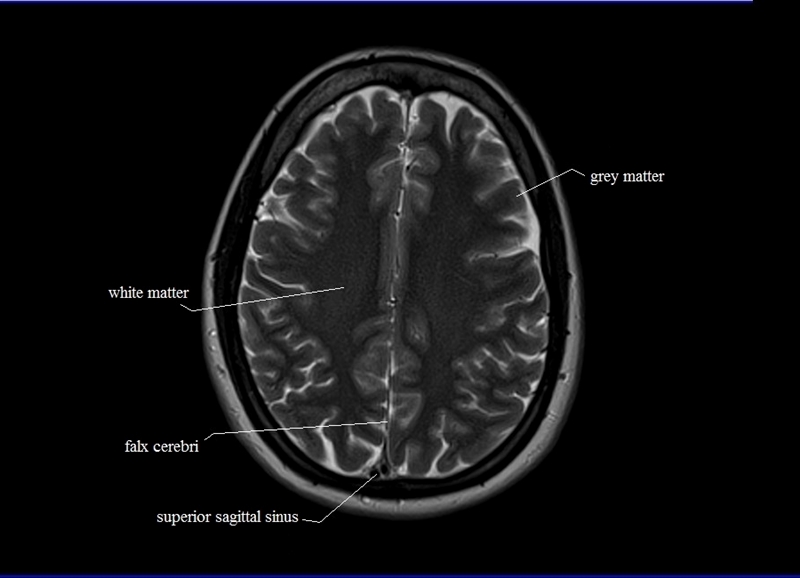
The MRI scanner is basically a piece of equipment that studies the magnetic properties of tissues. Each tissue has different magnetic parameters, and, more importantly, these parameters normally vary when there is an injury. This fact allows the team to make different types of images, assigning a specific gray scale to the different magnetic parameters that it measures.
The advantage of having the possibility of obtaining different contrasts is that it allows for detecting a greater number of lesions, those that are invisible in one type of contrast stand out in another, as is the case with this ischemic lesion due to blockage of an artery:
brain magnetic resonance imaging lesions
Therefore, a brain MRI scan usually consists of several images, each of which is acquired in between 2 and 8 minutes. Hence the total duration of the scan.
But how does the teamwork?
To study the magnetic properties of tissues we need a magnetic field and, for this, a magnet. In short, it is what the tube is: a huge electromagnet (electric current rotating through a circuit that generates a magnetic field) with enough force to lift a car.
For this reason, MRI is contraindicated in people with pacemakers (it could stop) and other metallic, electronic magnetic devices. When the person is introduced into the tube, each of their tissues is magnetized according to their characteristics, very little but enough to be detected and to carry out the study. The team searches for the MRI of the tissues with radio waves.
This is another advantage of magnetic resonance imaging: it does not use X-rays or ionizing radiation, only radio waves in the region of the modulated frequency (FM from 63 to 126 MHz, depending on the team) that are harmless.
Magnetic resonance makes the magnetization of the tissues vary in direction. When the magnetic resonance ceases, magnetic relaxation occurs, the way back to the starting position, each tissue at its own speed. The magnetic relaxation in turn generates a wave that is picked up by an antenna. The information from the wave is sent to a computer that reconstructs the layout of the tissues, thereby generating the image.
Brain MRI as a research tool
Since its inception, magnetic resonance imaging has aroused the interest of scientists. For Dr. Falcón “its versatility allows obtaining not only anatomical images in different contrasts, but also dynamic and functional images, extremely useful information in understanding the functioning of the brain and the processes involved in any pathology. What was previously only could verify in post-mortem studies it is now visible in vivo with scans, somewhat annoying but innocuous, of just under an hour” for more info visit labuncle.com.
The main difference between MRI used for diagnosis or as a research tool is the precision, much higher in the case of research, and often the type of information that is obtained from the tissues. Let’s review some research explorations in neuroimaging with magnetic resonance:
1) Anatomical images
The objective is to know the anatomy of the brain with maximum precision, to take reliable measurements that can be monitored over time. The difference with equivalent diagnostic images is only the resolution.
Below is an example of a diagnostic image (left), its equivalent in research (center) and super-resolution (right). The first is sufficient to rule out pathology, but is it the quantitative measurements would be inaccurate due to the blurring of the edges.
2) Anatomical images without diagnostic value
This case would be, for example, the study of white matter tracts that inform which part of the brain is connected to which other part and the strength of these connections (an example below). This information allows us to understand the network structure of the brain and its functioning when performing different tasks.
3) Functional images
Complementary to the previous one. It determines which part of the brain is activated or deactivated when performing a certain task and allows us to understand how the brain works (below, the activation when listening to emotional music, with the activation of the auditory -lateral-, emotional -central- and frontal -the superior cortex -) and what goes wrong when there is mental dysfunction. They also make it possible to determine which parts of the brain work synchronously in the resting state of mental activity.
4) Dynamic images
For example, the measurements of flow in a blood vessel, which allow determining how much blood and at what speed it passes through a certain artery; the carotids in the image below. It also makes it possible to indirectly determine some parameters such as the stiffness of the arteries or lipid plaques, which help determine a person’s vascular risk.


dark markets darknet sites
darknet links how to get on dark web
dark web link tor market url
dark web sites bitcoin dark web
dark web site tor market links
dark web access deep web drug url
darkmarket 2023 dark web sites
darknet drugs bitcoin dark web
darkmarket link darknet search engine
dark web site tor darknet
dark web websites deep web drug store
drug markets dark web dark web access
best darknet markets how to access dark web
tor market darknet search engine
dark web market list how to access dark web
dark web search engine darkmarkets
dark web market dark website
darknet drugs darkmarkets
dark market onion darknet drug store
deep web drug store darknet links
dark internet darkmarkets
deep web drug url darknet seiten
how to get on dark web deep web drug links
dark market link darkmarkets
dark web access drug markets onion
dark markets 2023 darknet market links
dark web market deep web drug store
tor market darknet drug links
drug markets onion darkmarkets
darknet search engine dark markets 2023
darkmarket url darknet search engine
darknet seiten blackweb official website
tor market url darknet websites
tor dark web dark web drug marketplace
deep web drug url darknet market lists
darknet market list darknet site
free dark web how to get on dark web
dark web search engine deep web sites
dark web site how to access dark web
dark web market darknet site
darkweb marketplace tor markets
deep web search deep web drug store
deep web drug store dark web market
tor darknet deep web links
drug markets dark web dark website
darknet market links dark web markets
blackweb dark web search engines
darkweb marketplace dark web links
darknet marketplace dark website
deep web search tor darknet